Regional Marketing
Published 30 April 2025 · Updated 15 November 2026
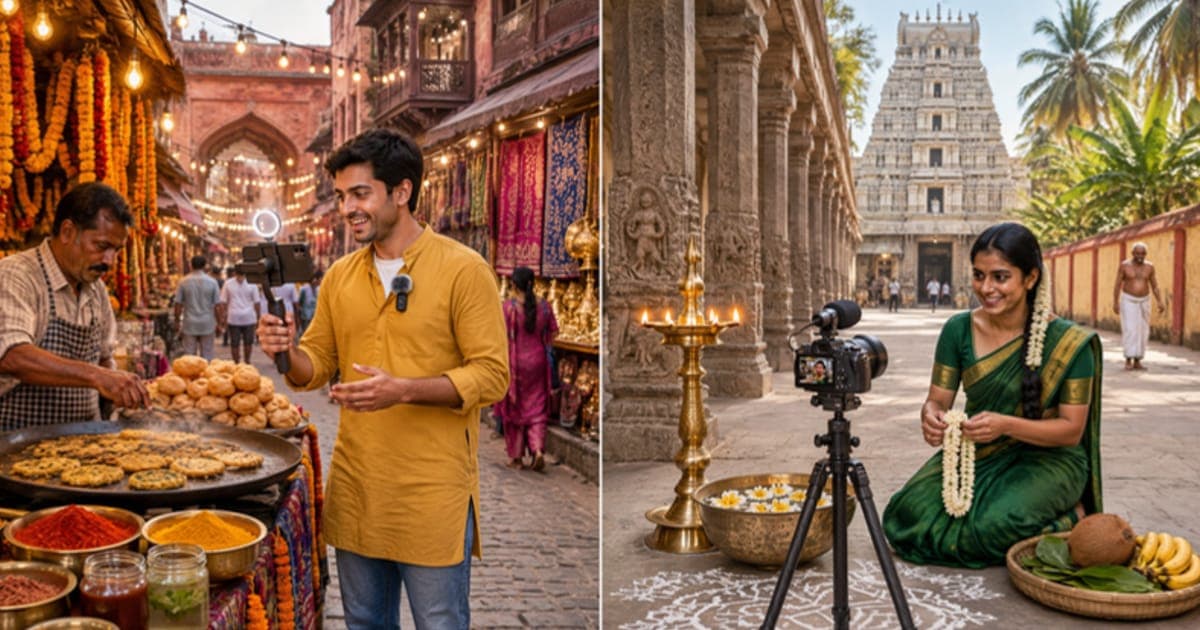
"North India" and "South India" are themselves oversimplifications , Punjab and Bihar differ enormously, as do Kerala and Telangana. But at a broad strategic level, brands running pan-India campaigns do need to account for real differences in how influencer marketing works across these two halves of the country, beyond just "translate into different languages." Here's a grounded look at what actually differs, and what doesn't.
North India has a degree of linguistic commonality that doesn't exist in the South. Hindi serves as a widely understood (if not always preferred) language across much of the Hindi Belt , Uttar Pradesh, Bihar, Madhya Pradesh, Rajasthan, Haryana , even though regional languages and dialects (Bhojpuri, Awadhi, Haryanvi, Rajasthani variants) remain important for genuine local connection.
Reelax's influencer directory by language reflects this divide well. South India has no equivalent lingua franca across states. Tamil Nadu, Kerala, Karnataka, and Andhra Pradesh/Telangana each have their own primary language (Tamil, Malayalam, Kannada, Telugu) with limited cross-comprehension, and Hindi is often less widely spoken or actively resisted as a primary marketing language in some of these states. A campaign that works with Hindi-language creators across "the North" with some regional variation might need four entirely separate language tracks to cover the South properly , Tamil, Malayalam, Kannada, and Telugu creators, each producing genuinely distinct content, not variations of a shared script.
South Indian markets , particularly Tamil Nadu and Kerala , have historically shown stronger preference for regional and local brands in certain categories (FMCG, food, even some fashion segments) compared to some North Indian markets where national/Hindi-dominant brands have had longer-established presence. This means influencer content that feels like it's coming from "outside" , a Mumbai-based brand's campaign dubbed into Tamil , can face a slightly higher trust barrier in parts of the South than the same dynamic might face in, say, Madhya Pradesh, where national brands have long been part of the everyday landscape.
This isn't universal , plenty of national brands are well-established and trusted across the South too , but it reinforces why genuinely local creator voices matter even more in southern markets, and why "translation exercise" campaigns tend to underperform more visibly there.
As covered in detail elsewhere, South India's major festival windows , Pongal/Sankranti (January), Ugadi/Vishu/Puthandu (March-April), and especially Onam (August-September) in Kerala , don't map onto the North-India-centric Diwali/Holi/Raksha Bandhan calendar that many national campaigns are built around. A campaign calendar built primarily around North Indian festivals risks missing some of the South's biggest commercial windows entirely, particularly Onam, which represents one of Kerala's highest-spending periods of the year.
Several southern states, particularly Kerala and parts of Tamil Nadu and Karnataka, have historically shown higher per-capita income and consumer spending in certain categories compared to many northern states outside major metros , partly linked to remittance income (especially in Kerala, with its large diaspora in the Gulf) and stronger urbanization patterns in some southern states. This affects category relevance , premium FMCG, gold/jewellery, and certain fashion segments can have stronger southern relevance than a purely population-weighted view of India would suggest.
While Instagram and YouTube dominate across India broadly, there are some regional nuances in content style. South Indian audiences , particularly in Tamil Nadu and Kerala , have shown strong engagement with longer-form YouTube content (vlogs, detailed reviews, cooking content) alongside Reels, partly reflecting established YouTube creator communities in these languages that predate the short-form video boom. North Indian markets, particularly Hindi-belt Tier 2/3 cities, have seen explosive growth in short-form video specifically, partly via platforms that gained early traction in these markets.
This doesn't mean one format is "better" in either region , but it does mean a content strategy heavily weighted toward short Reels might need a complementary longer-form YouTube component for southern markets to fully capture engaged audiences there.
It's worth being clear about what's consistent across North and South: the broad pattern that smaller creators are often trusted more than celebrities, and that regional creators deliver more for the money than metro names , Reelax's Creator Economy Report H1 2026, drawn from 40,000+ brand-creator collaborations, found regional micro creators out-engage metro macro creators by 2-3x at about a tenth of the cost per post , holds in both regions, a pattern explored further in our ROI measurement guide. The mechanics of why creator marketing works , trust, relatability, local language , are the same; what differs is the specific languages, festivals, and cultural references that make a creator's content feel genuinely local versus generic.
Rather than building "a North campaign" and "a South campaign," a more useful mental model is building a set of regional creator networks-Reelax's influencer directory by city is a good starting point for sourcing across both halves of the country , Tamil Nadu, Kerala, Karnataka, Telugu states, Punjab/Haryana, UP/Bihar (Hindi belt), Maharashtra/Gujarat, and so on , each with its own festival calendar, language-appropriate creators, and locally-relevant creative direction, coordinated centrally but executed regionally. The North-South framing is a useful starting point for recognizing that "one campaign, dubbed everywhere" doesn't work, but the real planning unit is the individual language/regional market, of which there are considerably more than two.
The regional picture is now much better documented on both sides of the divide. In the North, Reelax's Uttar Pradesh Creator Landscape Report 2027 lists 110,888 influencers based in UP alone, across 107 cities and towns, with the biggest pools in Lucknow, Noida, Kanpur, Ghaziabad, Varanasi, Agra and Meerut. That is a reminder that "the Hindi belt" is not one market either: a single state has enough creators to run a city-by-city network on its own.
Platform benchmarks have sharpened the format question too. Reelax's October 2026 data on 1,510 Indian YouTube channels shows median engagement falling steeply with size, from 0.81% for nano channels to 0.06% for mega channels, while median Instagram engagement ran from 1.91% for micro creators to 3.50% for mega creators. If your southern plan leans on long-form YouTube, smaller channels are where engagement is strongest , and our YouTube Shorts playbook for Indian brands covers how to pair long-form with short-form.
The North-South distinction is real and matters , different languages, different festival calendars, different platform habits, and in some categories, different brand trust dynamics. But it's better understood as a reminder that India isn't one market (or even two) than as a binary playbook to follow. Brands that build genuinely regional creator networks , Tamil, Malayalam, Kannada, Telugu, Punjabi, Bhojpuri, Marathi, Bengali, and more, each with its own calendar and creative direction , will naturally account for North-South differences as a byproduct of getting the more granular regional picture right.
Search Reelax's verified database of 1M+ Indian creators across 4,000+ cities and 12 languages, and shortlist the right voices for your next campaign.
Continue exploring with the Reelax blog archive, see real results in our case studies, or plan a campaign with our free marketing tools.
Reelax is an AI-powered influencer marketing platform for Indian brands. It reads every creator's growth, engagement and audience signals so you shortlist the right people in minutes, not weeks.
Tamil food creators in Chennai, 50K-500K
Discover 1M+ verified creators across 4,000+ cities, 780+ categories, and 12 languages - with fake-follower checks, cost calculators, and deep data metrics to find the ideal match for every campaign.